Harpactea strandjica Dimitrov, 1997
Description
Male
Bulb: conductor with a strong tubercle at its middle, embolus with a bifurcated tip. Prosoma 2.1-2.8 mm long.
Body length male: 5.15-6 mmFemale
Prosoma red-brown, ocular area darker. Prosoma 2.8 mm long. Legs orange-red, femur I with 2 prolateral spines, femur II with 2 or 3 prolateral spines, coxa IV with 2 to 5 dorsal spines, patella III usually with one spine.
Body length female: 6.5-6.75 mmDistribution
Phenology
| Jan | Feb | Mar | Apr | May | Jun | Jul | Aug | Sep | Oct | Nov | Dec |
 |  |
Figures
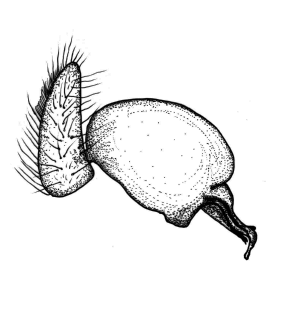
Pedipalp, retrolateral view
(Lazarov 2009a)
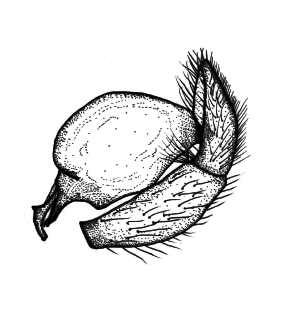
Pedipalp, prolateral view
(Lazarov 2009a)
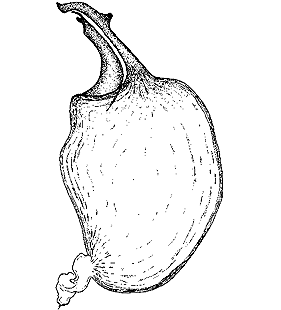
Bulbus, lateral view
(Dimitrov 1997)
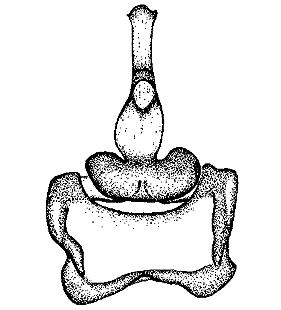
Vulva, dorsal view
(Dimitrov 1997)
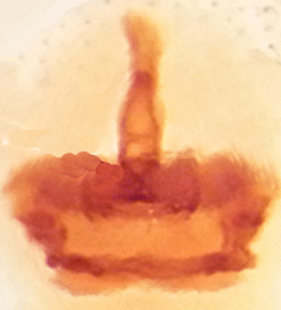
Vulva
(Dimitrov 2018b)
Distribution List
References
Blagoev G, Deltshev C, Lazarov S, Naumova M (2018) The spiders (Araneae) of Bulgaria. Version: August 2018. National Museum of Natural History, Bulgarian Academy of Sciences. Online at http://www.nmnhs.com/spiders-bulgaria/ (accessed on 10.9.2018) 
Demircan Aksan N, Topçu A (2022c) A preliminary checklist of the spider fauna of European Türkiye. Serket 19: 39-56
Demircan N, Topçu A (2015) A contribution to the spider fauna of the European part of Turkey (Araneae). Serket 14: 176-183
Dimitrov D (1997) Description of Harpactea strandjica, sp. n. from Bulgaria (Araneae, Dysderidae). Bulletin of the British Arachnological Society 10: 322
Dimitrov D (2018b) A contribution to the study of Turkish Dysderidae with description of a new Dysdera (Araneae, Dysderidae). Arachnology 17: 457-462
Lazarov S (2009a) A new spider species from Bulgaria, Harpactea terveli sp. n. (Araneae, Dysderidae). International Journal of Academic Research 1: 96-98
WSC (2026) World Spider Catalog. Version 27. Natural History Museum Bern, online at http://wsc.nmbe.ch (20.5.2026) doi: 10.24436/2