Harpactea strandjica Dimitrov, 1997
Beschreibung
Männchen
Bulbus: Konduktor mit einem kräftigen Tuberkel in der Mitte, Embolus mit einer gegabelten Spitze. Prosoma 2.1-2.8 mm lang.
Körperlänge Männchen: 5.15-6 mmWeibchen
Prosoma rot-braun, Augenbereich dunkler. Prosoma 2.8 mm lang. Beine orange-rot, Femur I mit 2 prolateralen Stacheln, Femur II mit 2 oder 3 prolateralen Stacheln, Coxa IV mit 2 bis 5 dorsalen Stacheln, Patella III gewöhnlich mit einem Stachel.
Körperlänge Weibchen: 6.5-6.75 mmVerbreitung
Phänologie
| Jan | Feb | Mar | Apr | May | Jun | Jul | Aug | Sep | Oct | Nov | Dec |
 |  |
Abbildungen
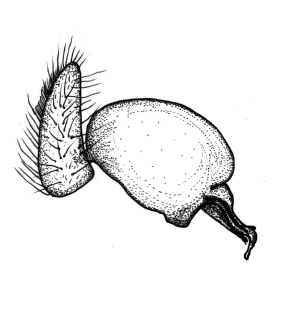
Pedipalpus, retrolateral
(Lazarov 2009a)
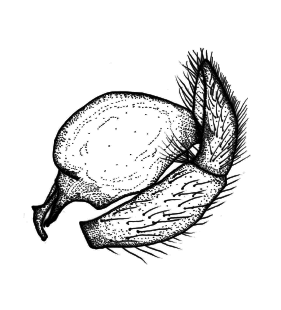
Pedipalpus, prolateral
(Lazarov 2009a)
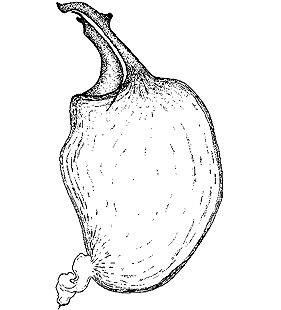
Bulbus, lateral
(Dimitrov 1997)
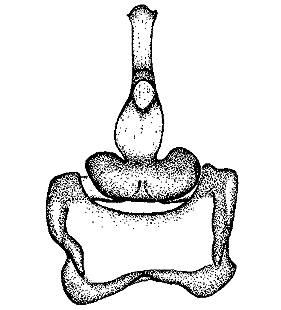
Vulva, dorsal
(Dimitrov 1997)
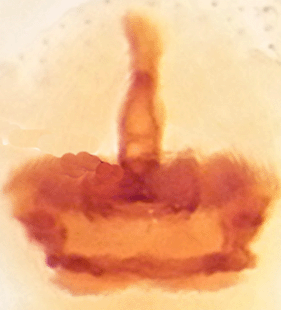
Vulva
(Dimitrov 2018b)
Verbreitungsnachweise
Literatur
Blagoev G, Deltshev C, Lazarov S, Naumova M (2018) The spiders (Araneae) of Bulgaria. Version: August 2018. National Museum of Natural History, Bulgarian Academy of Sciences. Online at http://www.nmnhs.com/spiders-bulgaria/ (accessed on 10.9.2018) 
Demircan Aksan N, Topçu A (2022c) A preliminary checklist of the spider fauna of European Türkiye. Serket 19: 39-56
Demircan N, Topçu A (2015) A contribution to the spider fauna of the European part of Turkey (Araneae). Serket 14: 176-183
Dimitrov D (1997) Description of Harpactea strandjica, sp. n. from Bulgaria (Araneae, Dysderidae). Bulletin of the British Arachnological Society 10: 322
Dimitrov D (2018b) A contribution to the study of Turkish Dysderidae with description of a new Dysdera (Araneae, Dysderidae). Arachnology 17: 457-462
Lazarov S (2009a) A new spider species from Bulgaria, Harpactea terveli sp. n. (Araneae, Dysderidae). International Journal of Academic Research 1: 96-98
WSC (2026) World Spider Catalog. Version 27. Natural History Museum Bern, online at http://wsc.nmbe.ch (20.5.2026) doi: 10.24436/2