Erigone tenuimana Simon, 1884
Description
Male
Resembles E. cristopalpus and E. tirolensis, but it is clearly smaller in the dimensions. Rudimentary posterior tooth of the embolic division, from cristatopalpus they can also be distinguished by their relatively smaller tibial pit, from tirolensis by the shape of the apophysis-like retrolateral border of the pit.
Prosoma length: 0.9 mm, prosoma width: 0.7 mm.
Body length male: 2 mmFemale
Resembles E. cristopalpus and E. tirolensis. Characteristic shape of the lateral and median plates of the vulva and lack of anteriolateral teeth on the chelicerae.
Prosoma length: 1.0 mm, prosoma width: 0.7 mm.
Distribution
Figures
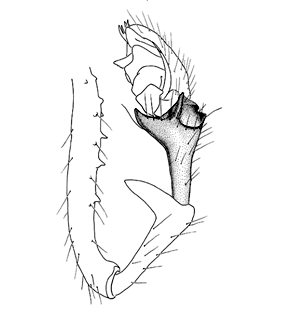
 Pedipalp, retrolateral view
(Muster & Hänggi 2009)
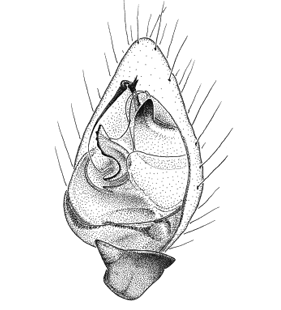
Pedipalp, ventral view
(Muster & Hänggi 2009)
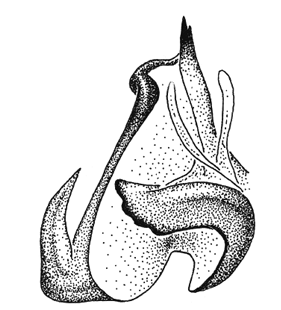
Embolic division, prolateral-ventral view
(Muster & Hänggi 2009)
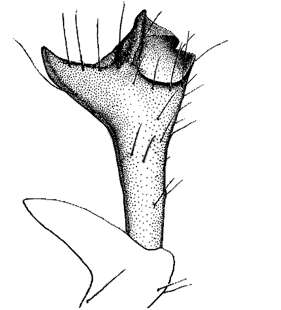
Palpal tibia, retrolateral view
(Muster & Hänggi 2009)
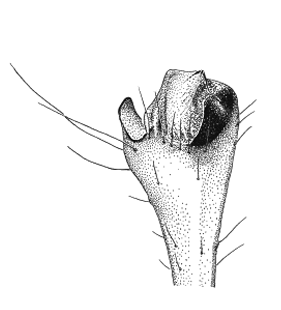
Palpal tibia
(Muster & Hänggi 2009)
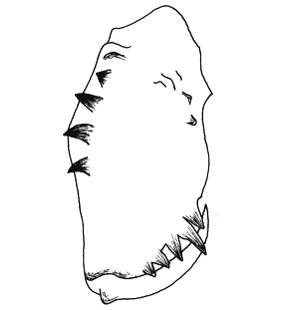
Chelicera
(Muster & Hänggi 2009)
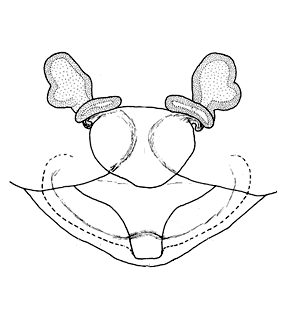
 Vulva, dorsal view
(Muster & Hänggi 2009)
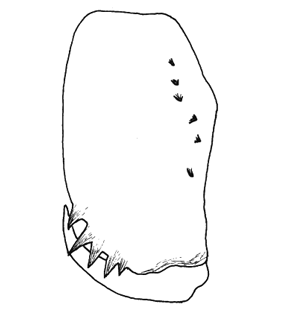
Chelicera
(Muster & Hänggi 2009)
Distribution List
References
Blick T, Finch O-D, Harms K H, Kiechle J, Kielhorn K-H , Kreuels M, Malten A, Martin D, Muster C, Nährig D, Platen R, Rödel I, Scheidler M, Staudt A, Stumpf H, Tolke D (2016) Rote Liste und Gesamtartenliste der Spinnen (Arachnida: Araneae) Deutschlands. 3. Fassung, Stand April 2008, einzelne Änderungen und Nachträge bis August 2015. Naturschutz und Biologische Vielfalt 70/4: 383-510 
Isaia M, Tolve M, Pantini P (2025) Araneae.it: 2.0: the new updated version of the digital catalog of the Italian spiders and other arachnids (Arachnida: Araneae, Opiliones, Scorpiones, Pseudoscorpiones, Palpigradi, Solifugae). Fragmenta Entomologica 57: 197-204
Muster C, Hänggi A (2009) The Erigone psychrophila group in the Alps (Araneae: Linyphiidae). Contributions to Natural History 12: 987-1005
WSC (2026) World Spider Catalog. Version 27. Natural History Museum Bern, online at http://wsc.nmbe.ch (20.5.2026) doi: 10.24436/2