Erigone aletris Crosby & Bishop, 1928
Beschreibung
Tibialapophyse mit spitz-dreieckigem dorsalem Fortsatz. Epigyne hochgeklappt und von hinten betrachtet ± dreieckig, Receptacula seminis nicht durchscheinend.
Körperlänge Männchen: 1.7-2.1 mmKörperlänge Weibchen: 2.1-2.2 mm
Zusätzliche Informationen
Diese Art stammt aus Nordamerika und ist daher nicht-einheimisch für Europa. Sie wurde mindestens einmal nach Europa eingeschleppt und hat sich etabliert.
Merkmalsliste Linyphiidenschlüssel
Verbreitung
Phänologie
| Jan | Feb | Mar | Apr | May | Jun | Jul | Aug | Sep | Oct | Nov | Dec |
 |  |
Abbildungen
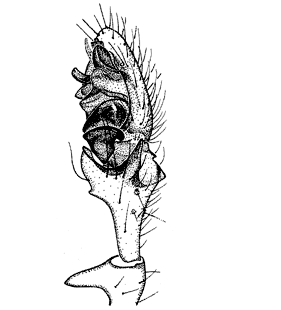
Pedipalpus
(Roberts 1987)
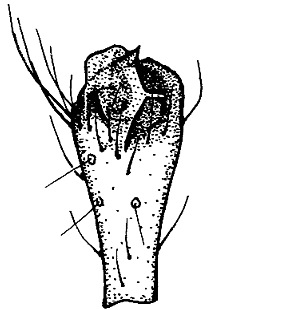
Tibialapophyse
(Roberts 1987)
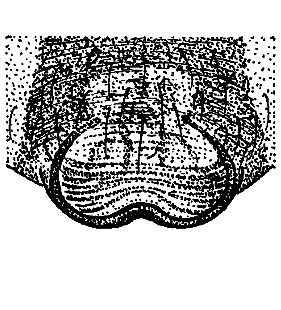
Epigyne
(Roberts 1987)
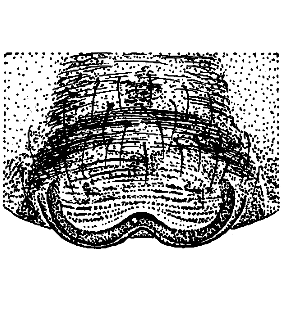
Epigyne
(Roberts 1987)
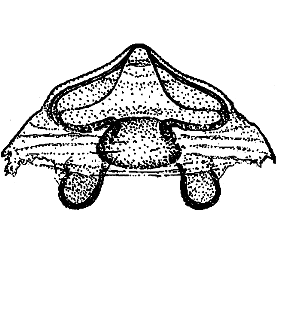
Epigyne, hochgeklappt
(Roberts 1987)
Verbreitungsnachweise
Literatur
Isaia M, Tolve M, Pantini P (2025) Araneae.it: 2.0: the new updated version of the digital catalog of the Italian spiders and other arachnids (Arachnida: Araneae, Opiliones, Scorpiones, Pseudoscorpiones, Palpigradi, Solifugae). Fragmenta Entomologica 57: 197-204 
Lavery A (2019) A revised checklist of the spiders of Great Britain and Ireland. Arachnology 18: 196-212
Roberts M J (1987) The spiders of Great Britain and Ireland. Volume 2: Linyphiidae and checklist. Harley Books Colchester, England, 204 pp.
Wilson R (2015) Philodromus buxi and Anyphaena sabina: two new records for the UK. Newsletter of the British Arachnological Society 132: 17-19
WSC (2026) World Spider Catalog. Version 27. Natural History Museum Bern, online at http://wsc.nmbe.ch (20.5.2026) doi: 10.24436/2
Updates
| 29-08-2023 | Distribution update | Detail |