Xysticus xerodermus Strand, 1913
Beschreibung
Männchen
Prosoma rotbraun, mit einem braunen, keilförmigen Flecken umschlossen von einem gelblichen Mittelband. Prosomalänge: 2.1-2.5 mm. Beine braun, weiß gesprenkelt. Opisthosoma blassbraun, dorsal mit braunem Mittelband, gezackt.
Körperlänge Männchen: 4.3-5.4 mmWeibchen
Färbung wie Männchen außer Opisthosoma: dorsales Medianband nur sehr schwach ausgeprägt. Prosomalänge: 2.6-3.2 mm.
Körperlänge Weibchen: 5.9-9.6 mmVerbreitung
Phänologie
| Jan | Feb | Mar | Apr | May | Jun | Jul | Aug | Sep | Oct | Nov | Dec |
 |  |
Abbildungen
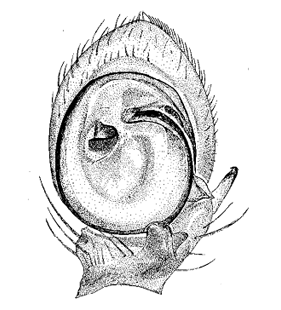
Pedipalpus, ventral
(Levy 1976)
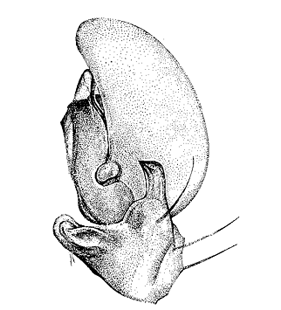
Pedipalpus, retrolateral
(Levy 1976)
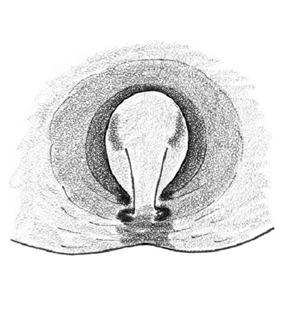
Epigyne, ventral
(Logunov & Demir 2006)
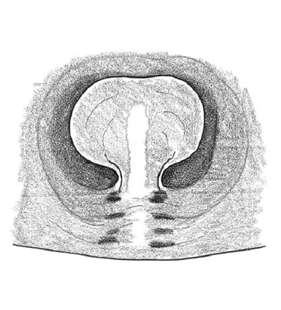
Epigyne, ventral
(Logunov & Demir 2006)
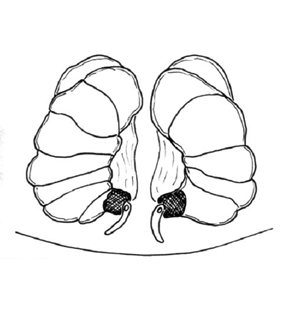
Vulva
(Logunov & Demir 2006)
Verbreitungsnachweise
Literatur
Bosmans R, Van Keer J, Russell-Smith A, Hadjiconstantis M, Komnenov M, Bosselaers J, Huber S, McCowan D, Snazell R, Decae A, Zoumides C, Kielhorn K-H, Oger P (2019c) Spiders of Cyprus (Araneae). A catalogue of all currently known species from Cyprus. Newsletter of the Belgian Arachnological Society 34, Suppl. 1: 1-173 
Danışman T, Kunt K B, Özkütük R S, Coşar İ (2025a) The checklist of the spiders of Turkey. Version 2025 [last updated 01 December 2025], online at http://www.spidersofturkey.info
Levy G (1976) The spider genus Xysticus (Araneae: Thomisidae) in Israel. Israel Journal of Zoology 25: 1-37
Logunov D V, Demir H (2006) Further faunistic notes on Cozyptila and Xysticus from Turkey (Araneae, Thomisidae). Arachnologische Mitteilungen 31: 40-45
Schröder M, Chatzaki M, Buchholz S (2011) The spider fauna of the Aladjagiola wetland complex (Nestos Delta, north-east Greece): a reflection of a unique zoogeographical transition zone in Europe. Biological Journal of the Linnean Society 102: 217-233
WSC (2026) World Spider Catalog. Version 27. Natural History Museum Bern, online at http://wsc.nmbe.ch (20.5.2026) doi: 10.24436/2