Centromerus phoceorum Simon, 1929
Description
Male
Paracymbium occupying 2/3 of bulbus length. Embolus gently curved, with subterminal tooth. Prosoma yellowish brown, with grey to dark grey striae, fovea and margin. Eyes broadly bordered with black. Legs yellowish brown, with grey markings in terminal part of the segments. Opisthosoma grey to dark grey.
Body length male: 1.2-1.5 mmFemale
Epigyne small, scapus hardly protruding. Colouration as in males.
Body length female: 1.5-2.0 mmDistribution
Figures
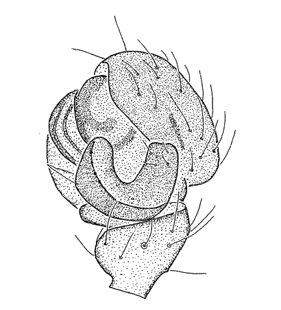
 Pedipalp, retrolateral view
(Bosmans 2006a)
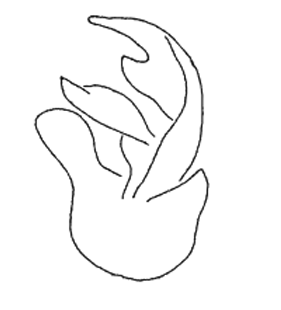
Embolic division, median view
(Bosmans 2006a)
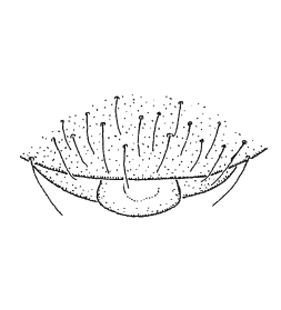
 Epigyne, ventral view
(Bosmans 2006a)
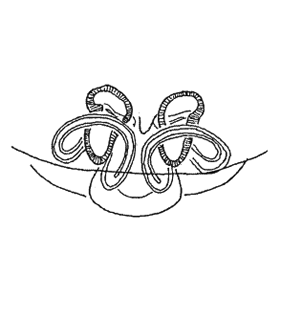
Vulva
(Bosmans 2006a)
Distribution List
References
Benhacene R, Adjami A, Hadjeb A, Kermiche K, Ouakid M L (2023) Bibliographic checklist of the Algerian spider fauna (Araneae). Zootaxa 5352: 301-357 
Bosmans R (1986) Études sur les Linyphiidae Nord-Africaines IV. Le genre Centromerus Dahl (Araneae: Linyphiidae). Biologisch Jaarboek Dodonaea 54: 85-103
Bosmans R (2006a) Contribution to the knowledge of the Linyphiidae of the Maghreb. Part XI. Miscellaneous linyphiid genera and additions (Araneae: Linyphiidae: Linyphiinae). Bulletin & Annales de la Société Entomologique de Belgique 141: 125-161
Branco V V, Morano E, Cardoso P (2019) An update to the Iberian spider checklist (Araneae). Zootaxa 4614: 201-254
Kmira G, Nasri-Ammar, Petillon J, Bosmans R (2025) Catalog of the spiders of Tunisia (Arachnida: Araneae). Zootaxa 5641: 1-95
Le Peru B (2007) Catalogue et répartition des araignées de France. Revue Arachnologique 16: 1-468
WSC (2026) World Spider Catalog. Version 27. Natural History Museum Bern, online at http://wsc.nmbe.ch (20.5.2026) doi: 10.24436/2