Harpactea serena (Simon, 1907)
Beschreibung
Männchen
Pedipalpus: Tarsus so lang wie Tibia, Bulbus beinahe so breit wie lang.
Weibchen
Prosoma hell rötlich. Sternum gelblich, mit feiner Körnung. Beine gelblich, Femur I gewöhnlich mit 2 Stacheln, Femur II mit einer Reihe von 2 oder 3 Stacheln, Femur III mit 3 bis 7 Stacheln, Femur IV mit 3 bis 5 Stacheln.
Körperlänge Weibchen: 5-6 mmZusätzliche Informationen
In kalkhaltigen Gebieten, Steineichenwäldern, Rebbergen.
Verbreitung
Phänologie
| Jan | Feb | Mar | Apr | May | Jun | Jul | Aug | Sep | Oct | Nov | Dec |
 |  |
Abbildungen
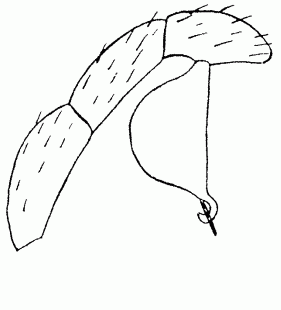
Pedipalpus
(Simon 1914)
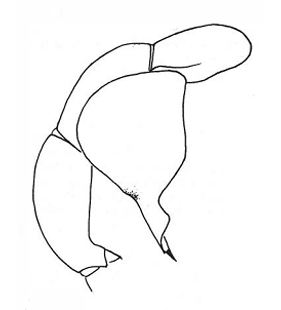
Pedipalpus, prolateral
(Ferrández & Fernández 1990)
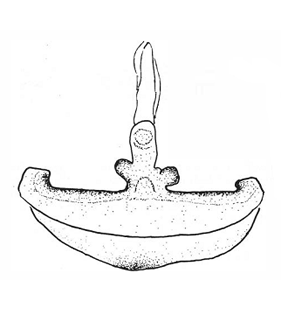
Vulva
(Ferrández & Fernández 1990)
Verbreitungsnachweise
Literatur
Branco V V, Morano E, Cardoso P (2019) An update to the Iberian spider checklist (Araneae). Zootaxa 4614: 201-254 
Ferrández M A, Fernández de C H (1990) Nuevos datos sobre las especies ibéricas del género Harpactea Bristowe, 1939 (Araneae, Dysderidae). Boletín de la Real Sociedad Española de Historia Natural (Seccion Biologica) 86: 39-53
Isaia M, Tolve M, Pantini P (2025) Araneae.it: 2.0: the new updated version of the digital catalog of the Italian spiders and other arachnids (Arachnida: Araneae, Opiliones, Scorpiones, Pseudoscorpiones, Palpigradi, Solifugae). Fragmenta Entomologica 57: 197-204
Le Peru B (2011) The spiders of Europe, a synthesis of data: Volume 1 Atypidae to Theridiidae. Mémoires de la Société Linnéenne de Lyon 2: 1-522
Simon E (1914) Les arachnides de France 6 (1). Paris (Roret): 1-308
WSC (2026) World Spider Catalog. Version 27. Natural History Museum Bern, online at http://wsc.nmbe.ch (20.5.2026) doi: 10.24436/2
Updates
| 09-12-2015 | Image insert |