Harpactea cressa Brignoli, 1984
Description
Male
Embolus transverse, thick, bent proximally. Conductor bifurcated with a large lamella-like plate and a very slender, sharp projection. Prosoma reddish brown. Prosoma 1.8 mm long. Sternum yellow. Eyes: anteriors less than one diameter apart. Legs: Femur I-II reddish brown, all other segments and legs III-IV yellow, femur I with 2 or 3 spines, femur II with 2 spines, femur III with 3 to 5 spines, femur IV with 4 to 7 spines. Abdomen yellowish.
Body length male: 3.4 mmFemale
Vulva with long and slender spermathecae, posterior diverticulum bent upwards. Prosoma 1.2-1.6 mm long.
Additional information
In litter under Quercus coccifera, pine forests, close to the sea. Altitude up to 1450 m.
Distribution
Phenology
| Jan | Feb | Mar | Apr | May | Jun | Jul | Aug | Sep | Oct | Nov | Dec |
 |  |
Figures
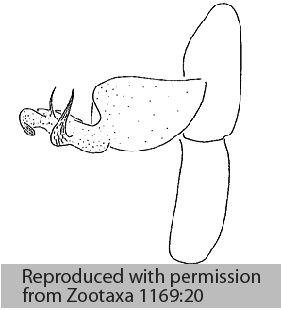
Pedipalp, retrolateral view
(Chatzaki & Arnedo 2006)
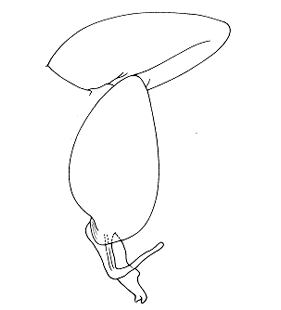
Bulbus, retrolateral view
(Brignoli 1984b)
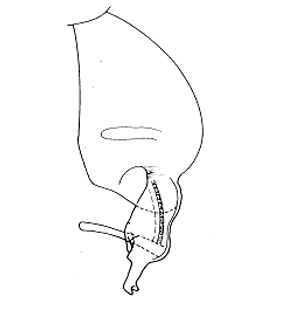
Bulbus, prolateral view
(Brignoli 1984b)
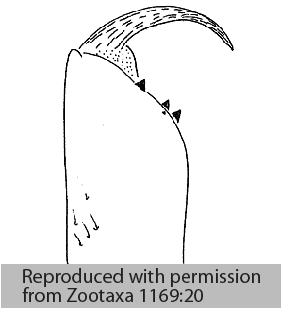
Chelicera, ventral view
(Chatzaki & Arnedo 2006)
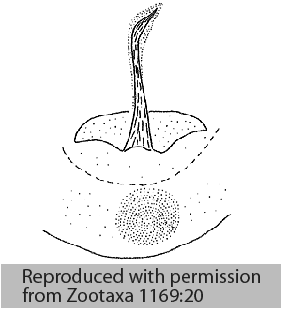
Vulva, ventral view
(Chatzaki & Arnedo 2006)
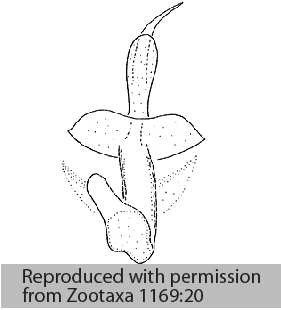
Vulva, dorsal view
(Chatzaki & Arnedo 2006)
Distribution List
References
Bosmans R, Chatzaki M (2005) A catalogue of the spiders of Greece – a critical review of all spider species cited from Greece with their localities. Nieuwsbrief van de Belgische arachnologische Vereniging 20 (2, suppl.): 1-124 
Brignoli P M (1984b) Ragni di Grecia XII. Nuovi dati su varie famiglie (Araneae). Revue Suisse de Zoologie 91: 281-321
Chatzaki M, Arnedo M A (2006) Taxonomic revision of the epigean representatives of the spider subfamily Harpacteinae (Araneae: Dysderidae) on the island of Crete. Zootaxa 1169: 1-32
Le Peru B (2011) The spiders of Europe, a synthesis of data: Volume 1 Atypidae to Theridiidae. Mémoires de la Société Linnéenne de Lyon 2: 1-522
WSC (2026) World Spider Catalog. Version 27. Natural History Museum Bern, online at http://wsc.nmbe.ch (20.5.2026) doi: 10.24436/2
Updates
| 21-07-2025 | Distribution update | Detail |
| 30-04-2013 | Image insert |