Pisaura quadrilineata (Lucas, 1838)
Description
Male
Resembles P. mirabilis.
Female
Resembles P. mirabilis. Epigyne: anterior triangle less developed, almost square, septum short and wide. Median plate very small with anterior border strongly curved. Halves of epigyneal depression very small, epigyne even more anchor-shaped than in other species. Copulatory ducts short and simple.
Distribution
Phenology
| Jan | Feb | Mar | Apr | May | Jun | Jul | Aug | Sep | Oct | Nov | Dec |
 |  |
Figures
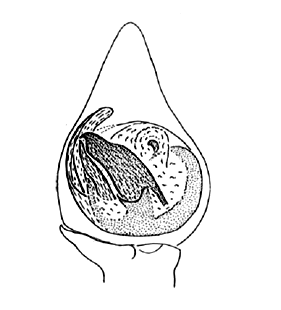
Pedipalp, ventral view
(Wunderlich 1992a)
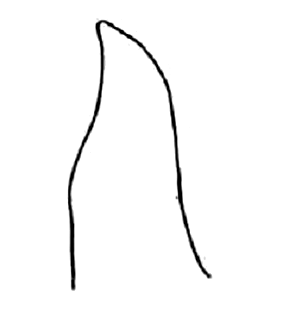
Palpal tibia, retrolateral view
(Wunderlich 1992a)
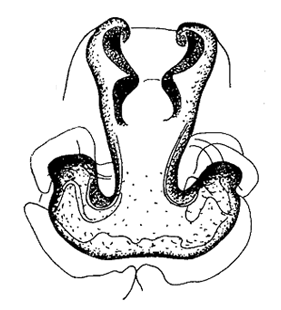
Epigyne
(Brignoli 1984a)
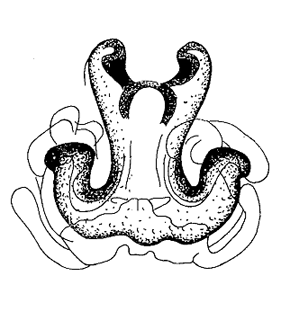
Epigyne
(Brignoli 1984a)
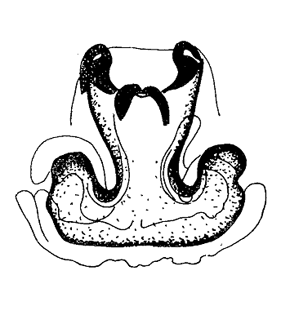
Epigyne
(Brignoli 1984a)
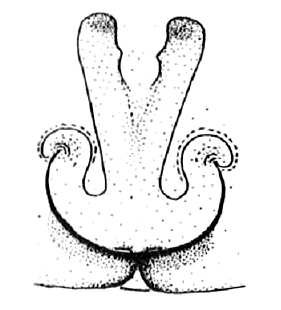
Epigyne, ventral view
(Wunderlich 1992a)
Distribution List
References
Brignoli P M (1984a) Zur Problematik der mediterranen Pisaura-Arten (Arachnida, Araneae, Pisauridae). Zoologischer Anzeiger 213: 33-43 
Isaia M, Tolve M, Pantini P (2025) Araneae.it: 2.0: the new updated version of the digital catalog of the Italian spiders and other arachnids (Arachnida: Araneae, Opiliones, Scorpiones, Pseudoscorpiones, Palpigradi, Solifugae). Fragmenta Entomologica 57: 197-204
Le Peru B (2007) Catalogue et répartition des araignées de France. Revue Arachnologique 16: 1-468
Pfliegler W A, Schönhofer A, Niedbała W, Vella P, Sciberras A, Vella A (2017) New records of mites (Acari) and harvestmen (Opiliones) from Malta with a preliminary checklist of Maltese Arachnida. Soil Organisms 89: 85-110
WSC (2026) World Spider Catalog. Version 27. Natural History Museum Bern, online at http://wsc.nmbe.ch (20.5.2026) doi: 10.24436/2
Wunderlich J (1992a) Die Spinnen-Fauna der Makaronesischen Inseln: Taxonomie, Ökologie, Biogeographie und Evolution. Beiträge zur Araneoleologie 1: 1-619