Pardosa incerta Nosek, 1905
Description
Male
Colouration as in females, but darker. Leg I with sexual dimorphism: distal segments on both sides with a dense fringe of long erect setae.
Female
Prosoma brown, median and lateral bands yellow, covered with white pubescence, median band spindle-shaped. Legs yellow-brown, all segments distinctly annulated. Opisthosoma yellow-brown, with pale pattern.
Additional information
Females can be confused with P. buchari.
Distribution
Phenology
| Jan | Feb | Mar | Apr | May | Jun | Jul | Aug | Sep | Oct | Nov | Dec |
 |  |
Figures
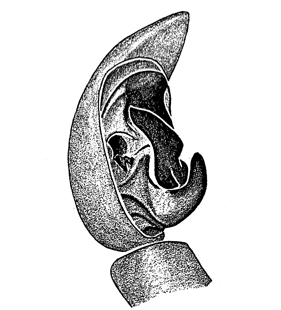
Pedipalp, retrolateral view
(Tongiorgi 1966b)
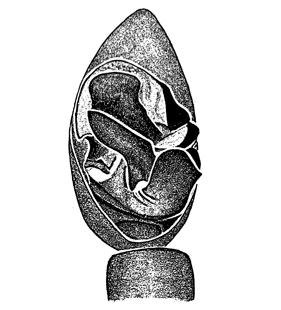
Pedipalp, ventral view
(Tongiorgi 1966b)
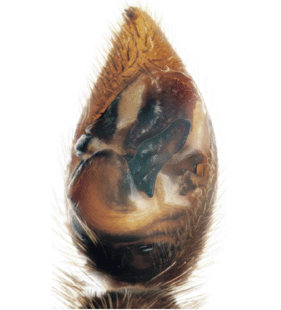
Pedipalp, ventral view
(Zamani et al. 2022b)
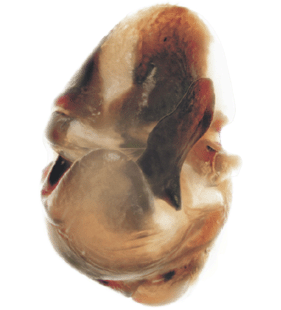
Bulbus, ventral view
(Zamani et al. 2022b)
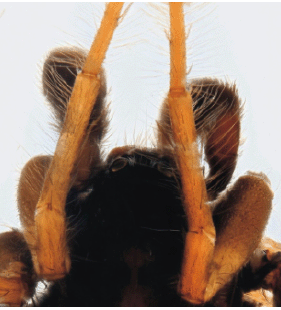
Prosoma, dorsal view
(Zamani et al. 2022b)
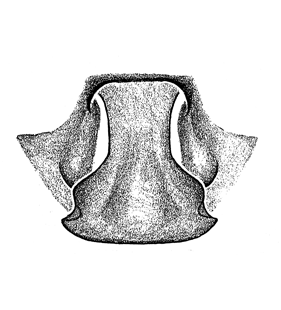
Epigyne, ventral view
(Tongiorgi 1966b)
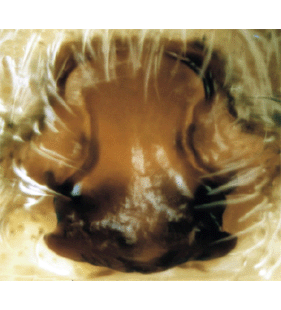
Epigyne
(Zamani et al. 2022b)
Distribution List
References
Blagoev G, Deltshev C, Lazarov S, Naumova M (2018) The spiders (Araneae) of Bulgaria. Version: August 2018. National Museum of Natural History, Bulgarian Academy of Sciences. Online at http://www.nmnhs.com/spiders-bulgaria/ (accessed on 10.9.2018) 
Danışman T, Kunt K B, Özkütük R S, Coşar İ (2025a) The checklist of the spiders of Turkey. Version 2025 [last updated 01 December 2025], online at http://www.spidersofturkey.info
Otto S (2022) Caucasian spiders. A faunistic database on the spiders of the Caucasus Ecoregion. Database version 02.2022. Internet: caucasus-spiders.info.
Tongiorgi P (1966b) Wolf spiders of the Pardosa monticola group (Araneae, Lycosidae). Bulletin of the Museum of Comparative Zoology 134: 335-359
WSC (2026) World Spider Catalog. Version 27. Natural History Museum Bern, online at http://wsc.nmbe.ch (20.5.2026) doi: 10.24436/2
Zamani A, Nadolny A A, Dolejš P (2022b) New data on the spider fauna of Iran (Arachnida: Araneae), part X. Arachnology 19: 551-573