Nemesia enix Calvo, 2025
Description
General orange color. Small size, almost circular carapace, and long, graceful legs covered with abundant spines. Prosoma with little hairiness around the eye and basal margin. Prominent, elongated chelicerae with a central longitudinal line of black bristles. Slightly elevated cephalic area, narrow, recurved fovea with a small median cleft.
Oval, creamy-gray abdomen, the same size as the prosoma, covered with abundant black bristles.
Long palps and legs covered with black bristles. The femora have only 4-5 dorsal spines in a central row. Tarsi I, II, and IV have a row of three very short central spines. Cymbium with 5 long spines and 6 shorter ones, 5 very long bristles on the ventral side of the tibia of the palp, and only one apical prolateral spine. The macrospine of tibia I is slightly curved towards the interior of the segment. Clasper field occupying more than two-thirds of metatarsal I, formed by small spines. It lacks grooming combs, only three long ventral spines at the base of metatarsal IV.
The bulb ventrally has a broad basal part, with the embolus curving slightly outward, with a thin, straight apical third and a blunt tip. In the retrolateral position, the basal part is almost spherical, and the embolus appears strongly curved, tapering at the tip.
Body length female: 11.7-14.0 mm
Distribution
Figures
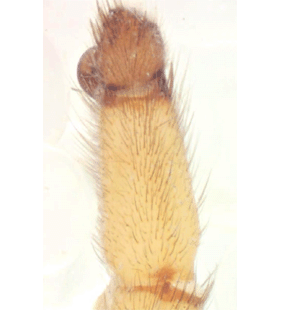
 Pedipalp, dorsal view
(Calvo 2025)
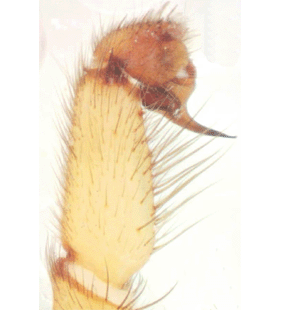
Pedipalp, prolateral view
(Calvo 2025)
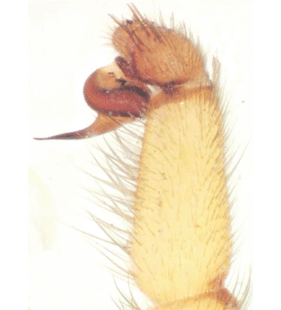
Pedipalp, retrolateral view
(Calvo 2025)
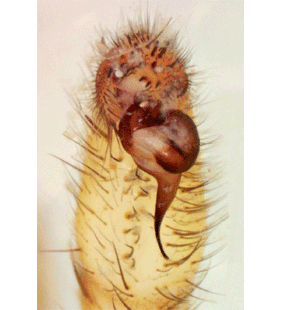
Pedipalp, ventral view
(Calvo 2025)
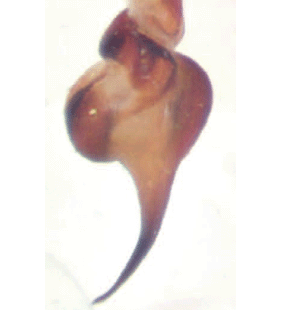
Bulbus
(Calvo 2025)
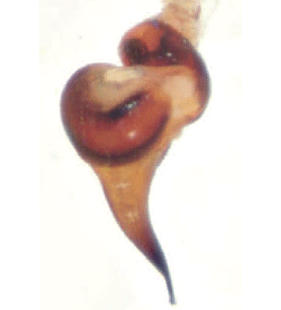
Bulbus
(Calvo 2025)
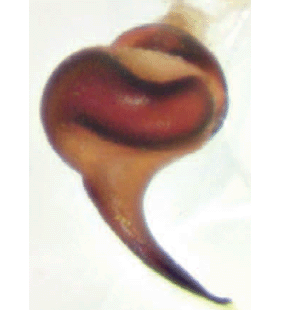
Bulbus
(Calvo 2025)
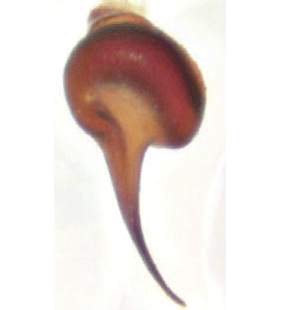
Bulbus
(Calvo 2025)
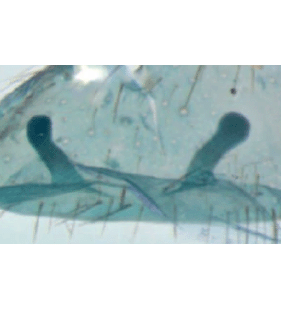
Spermathecae, dorsal view
(Calvo 2025)
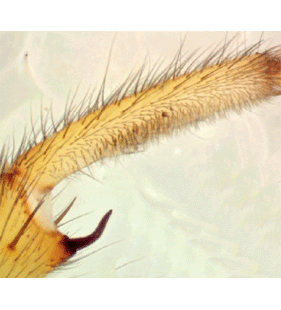
Tibial apophysis leg I, lateral view
(Calvo 2025)
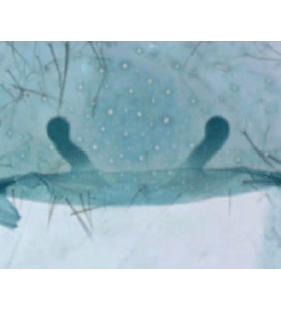
 Spermathecae, dorsal view
(Calvo 2025)
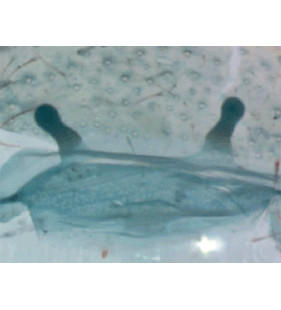
Spermathecae, dorsal view
(Calvo 2025)
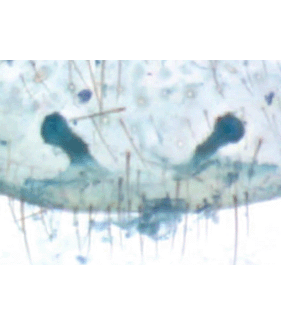
Spermathecae, dorsal view
(Calvo 2025)
Distribution List
References
Calvo M (2025) Nemesia enix n. sp.; descripción de una nueva especie de Nemesia (Aranae; Mygalomorphae, Nemesiidae) de la Península Ibérica. Revista Ibérica de Aracnología 46: 85-93 
WSC (2026) World Spider Catalog. Version 27. Natural History Museum Bern, online at http://wsc.nmbe.ch (20.5.2026) doi: 10.24436/2