Physocyclus globosus (Taczanowski, 1874)
Beschreibung
Zusätzliche Informationen
Diese Art stammt aus Nordamerika und ist daher nicht-einheimisch für Europa. Sie wurde mindestens einmal nach Europa eingeschleppt und es ist unklar, ob sie sich inzwischen etablieren konnte.
Verbreitung
Abbildungen

 Pedipalpus, retrolateral
(Baert et al. 2023)
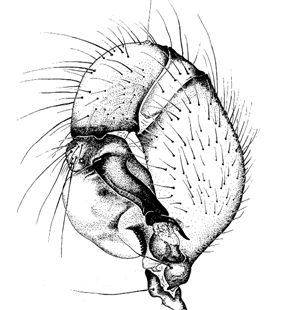
Bulbus, retrolateral
(Huber & Eberhard 1997)
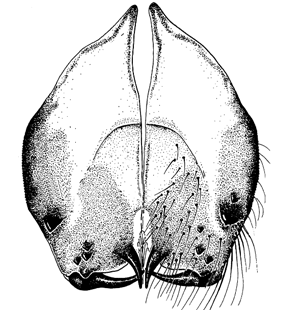
Cheliceren, frontal
(Huber & Eberhard 1997)
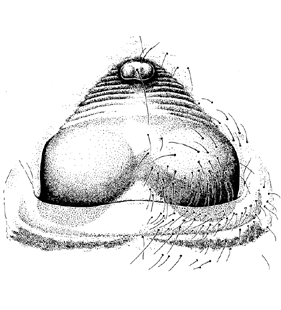
 Epigyne
(Huber & Eberhard 1997)

Epigyne
(Baert et al. 2023)
Verbreitungsnachweise
Literatur
Baert L, Maelfait J-P, Desender K, Hendrickx F, Dekoninck W, Berthet M, Bouckaert K, Caudron J, Leclercq M (2023) Updated checklist, origin, distribution, literature and genital drawings of the spiders of the Galápagos Islands Belgian Journal of Entomology 142: 1-188 
Huber B A, Eberhard W G (1997) Courtship, copulation, and genital mechanics in Physocyclus globosus (Araneae, Pholcidae). Canadian Journal of Zoology 74: 905-918
Řezáč M, Růžička V, Hula V, Dolanský J, Machač O, Roušar A (2021) Spiders newly observed in Czechia in recent years – overlooked or invasive species? BioInvasions Records 10: 555-566
Růžička V, Hula V (2017) Velké dobrodružství: Physocyclus globosus (Taczanowski, 1874) zavlečen do Evropy. Physocyclus globosus (Taczanowski, 1874) introduced to Europe. Pavouk 43: 4-5
WSC (2026) World Spider Catalog. Version 27. Natural History Museum Bern, online at http://wsc.nmbe.ch (20.5.2026) doi: 10.24436/2