Pardosa aquila Buchar & Thaler, 1998
Beschreibung
Männchen
Dunkel gefärbt. Prosomazeichnung undeutlich, Medianband verjüngt. Beine: Femora dunkel, Patellae und Tibiae schwärzlich übertönt. Metatarsi und Tarsi bräunlich. Opisthosoma dorsal mit lanzettförmigem Band und braunen, paarweise angeordneten Flecken.
Körperlänge Männchen: 5.8 mmWeibchen
Färbung wir Männchen.
Körperlänge Weibchen: 6.6-9.1 mmVerbreitung
Phänologie
| Jan | Feb | Mar | Apr | May | Jun | Jul | Aug | Sep | Oct | Nov | Dec |
 |  |
Abbildungen
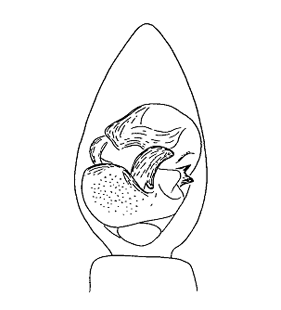
Pedipalpus, ventral
(Buchar & Thaler 1998)

Pedipalpus, ventral
(Demircan Aksan & Batur 2025)
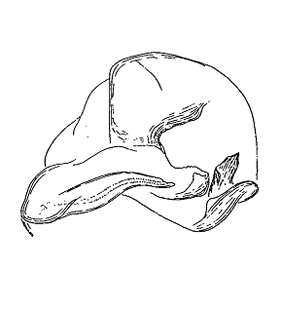
Endapparat
(Buchar & Thaler 1998)

Endapparat, ventral
(Demircan Aksan & Batur 2025)

Endapparat, ventral
(Demircan Aksan & Batur 2025)
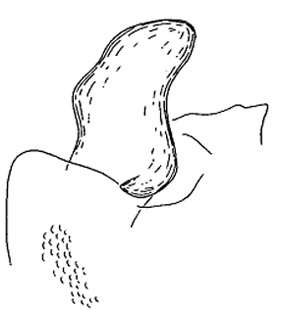
Tegularapophyse
(Buchar & Thaler 1998)
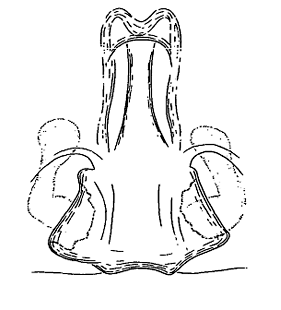
Epigyne, ventral
(Buchar & Thaler 1998)

Epigyne
(Demircan Aksan & Batur 2025)
Verbreitungsnachweise
Literatur
Akpınar A, Varol İ (2013) Contributions to the Turkish wolf spiders (Arachnida: Lycosidae). [note: Lycosa boninensis, Pardosa anomala and Trochosa abdita are not plausible and not included in Spiders of Europe] Acta Zoologica Bulgarica 65: 271-272 
Buchar J, Thaler K (1998) Lycosidae from the high alpine zone of the Caucasus range, with comparative remarks on the fauna of the Alps (Arachnida: Araneae). Linzer Biologische Beiträge 30: 705-717
Danışman T, Kunt K B, Özkütük R S, Coşar İ (2025a) The checklist of the spiders of Turkey. Version 2025 [last updated 01 December 2025], online at http://www.spidersofturkey.info
Demircan Aksan N, Batur Z (2025) First data on the spider fauna of Bayburt, with a new record and additional notes (Arachnida: Araneae). Cumhuriyet Science Journal 46: 478-482
Otto S (2022) Caucasian spiders. A faunistic database on the spiders of the Caucasus Ecoregion. Database version 02.2022. Internet: caucasus-spiders.info.
WSC (2026) World Spider Catalog. Version 27. Natural History Museum Bern, online at http://wsc.nmbe.ch (20.5.2026) doi: 10.24436/2