Creugas gulosus Thorell, 1878
Beschreibung
Körperfärbung dunkel rötlich-braun. Prosoma fein granuliert.
Körperlänge Männchen: 7.5-8.0 mmKörperlänge Weibchen: 7.5-8.0 mm
Zusätzliche Informationen
Diese Art ist nicht-einheimisch für Europa, ihr Ursprungsgebiet ist tropisch/subtropisch, aber nicht genauer bekannt, so dass sie als kryptogen gilt. Sie wurde mindestens einmal nach Europa eingeschleppt, konnte sich aber nicht etablieren.
Verbreitung
Abbildungen
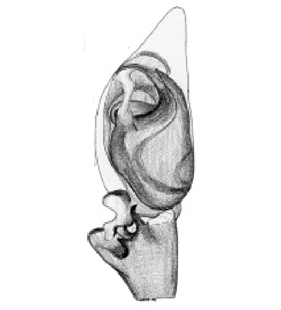
 Pedipalpus, ventral
(Saaristo 2002)

Pedipalpus, retrolateral
(Baert et al. 2023)

Pedipalpus, ventral
(Baert et al. 2023)
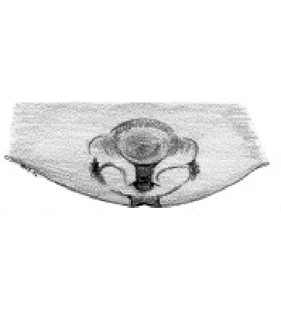
 Epigyne, ventral
(Saaristo 2002)
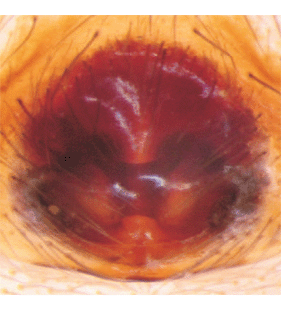
Epigyne
(Sherwood & Sharp 2023)

Epigyne
(Baert et al. 2023)
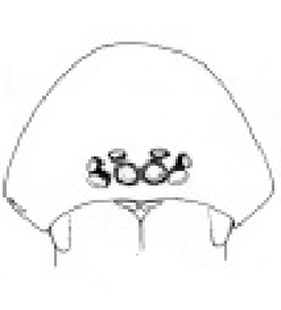
Prosoma, frontal
(Saaristo 2002)
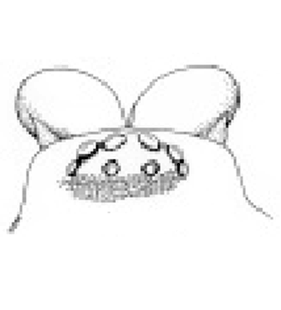
Prosoma, dorsal
(Saaristo 2002)
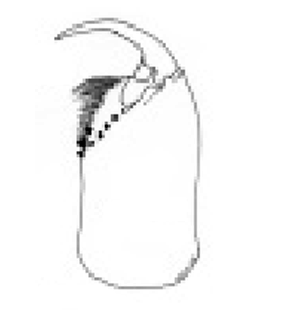
Chelicere, posterior
(Saaristo 2002)
Verbreitungsnachweise
Literatur
Baert L, Maelfait J-P, Desender K, Hendrickx F, Dekoninck W, Berthet M, Bouckaert K, Caudron J, Leclercq M (2023) Updated checklist, origin, distribution, literature and genital drawings of the spiders of the Galápagos Islands Belgian Journal of Entomology 142: 1-188 
Bosselaers J, Urones C, Barrientos J A, Alberdi J M (2009) On the Mediterranean species of Trachelinae (Araneae, Corinnidae) with a revision of Trachelas L. Koch 1872 on the Iberian Peninsula. Journal of Arachnology 37: 15-38
Pickard-Cambridge O (1911a) Arachnida. In: Additions to the wild fauna and flora of the Royal Botanical Gardens: XII. Bulletin of Miscellaneous Information (Royal Botanic Gardens, Kew) 12: 370-373
Saaristo M I (2002) New species and interesting new records of spiders from Seychelles (Arachnida, Araneaea [sic]). Phelsuma 10(suppl. A): 1-31
Sherwood D, Sharp A (2023) Familiar face, new destination: first records of the invasive spider Creugas gulosus Thorell, 1878 on Ascension Island (Araneae: Corinnidae). Revista Ibérica de Aracnología 43: 30-32
Wilson R (2012) An American jumper in Leeds, west Yorkshire and an update on non-native taxa recorded in the UK. Newsletter of the British Arachnological Society 123: 10-15
WSC (2026) World Spider Catalog. Version 27. Natural History Museum Bern, online at http://wsc.nmbe.ch (20.5.2026) doi: 10.24436/2