Folkia pauciaculeata (Fage, 1943)
Description
Male
Very similar to F. inermis. Eyes extremely reduced. Leg spination: leg I and II spineless, except femur with 5 spines, patella III and IV with one spine, femur III with 4 spines, femur IV with 5 spines, posterior tibia and metatarsus with numerous spines.
Body length male: 4.5 mmFemale
Unknown.
Additional information
Only one male specimen known. In cave.
Troglobiont species (Mammola et al., 2022)
Distribution
Figures
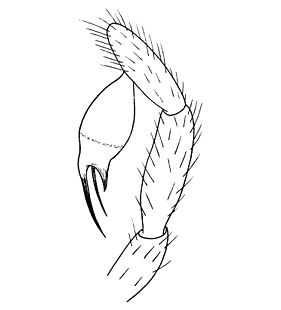
 Pedipalp
(Kratochvíl 1970)
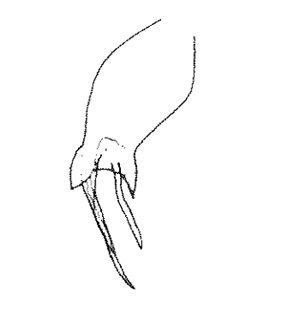
Bulbus
(Deeleman-Reinhold 1993)
Distribution List
References
Deeleman-Reinhold C L (1993) The genus Rhode and the harpacteine genera Stalagtia, Folkia, Minotauria, and Kaemis (Araneae, Dysderidae) of Yugoslavia and Crete, with remarks on the genus Harpactea. Revue Arachnologique 10: 105-135 
Deltshev C D (2008b) Faunistic diversity and zoogeography of cave-dwelling spiders on the Balkan Peninsula. p. 327-348. In: Makarov S E & Dimitrijevic R N (Eds): Advances in arachnology and developmental biology. Papers dedicated to Prof. Dr. Božidar Curcic. Monographs 12. 517 pp.
Katušić L (unpubl.) .
Kratochvíl J (1970) Cavernicole Dysderae. Přírodovědné práce ústavů Československé Akademie Věd v Brně (N.S.) 4: 1-62
Le Peru B (2011) The spiders of Europe, a synthesis of data: Volume 1 Atypidae to Theridiidae. Mémoires de la Société Linnéenne de Lyon 2: 1-522
Mammola S, Pavlek M, Huber B A, Isaia M, Ballarin F, Tolve M, Čupić I, Hesselberg T, Lunghi E, Mouron S, Graco-Roza C, Cardoso P (2022) A trait database and updated checklist for European subterranean spiders. Scientific Data 9(236): 1-13
WSC (2026) World Spider Catalog. Version 27. Natural History Museum Bern, online at http://wsc.nmbe.ch (20.5.2026) doi: 10.24436/2