Eresus kollari frontalis Latreille, 1817
Description
Male
Male unknown.
Female
González Sánchez (in litt.):
A large, compact, and robust-looking species. It reaches up to 23 mm in body length.
Juveniles are slate-gray in colour, with white spots all over their bodies and markings of the same colour on each of the leg joints and pedipalps.
In females, around their 4th or 5th molt, they begin to show the characteristic yellow colouration on the facial part of the prosoma and half of the basal segment of the chelicerae, as well as longitudinal lines of the same colour on the patellae and tibiae of legs I and II. This colouration intensifies with each molt, becoming ochre or reddish in mature females, but not in their final instar (they are known to molt even after reaching sexual maturity). On the abdomen, the white markings are concentrated on the anterior portion, where it connects to the prosoma, forming a patch that is lighter than the rest of the abdomen.
In the aforementioned final stage, which Dufour describes as "decrepitude," they turn jet black, and the white markings fade. Furthermore, the yellow or orange regions (legs, facial area, and chelicerae) turn beige/milky.
They are diurnal and frequent the same habitats as other species in the genus. They are capable of digging burrows of moderate depth, depending on the looseness of the substrate, which they line with cribellate silk in copper and pink tones, giving them a cottony appearance.
They are quite defensive when disturbed, raising their first two pairs of legs and opening their fangs in a threatening posture. Their movements are somewhat rapid but clumsy due to their build.
As for the males, although they remain undescribed, they are likely similar to those of the nominal species (Eresus kollari), perhaps with more intense red tones on the hind legs, as has been observed in unidentified males from their distribution range.
Distribution
Figures
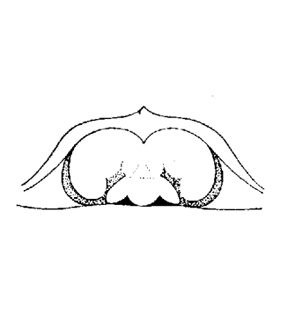
 Epigyne
(Bacelar 1936)
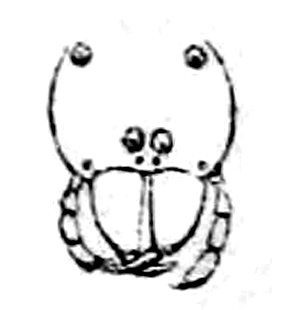
Prosoma, frontal view
(Dufour 1820)
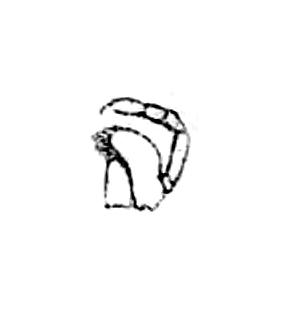
Gnathocoxa, ventral view
(Dufour 1820)
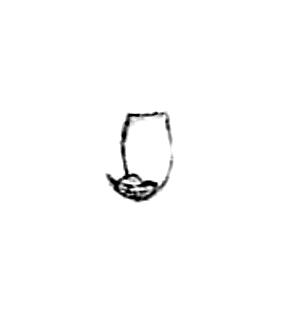
Chelicera
(Dufour 1820)
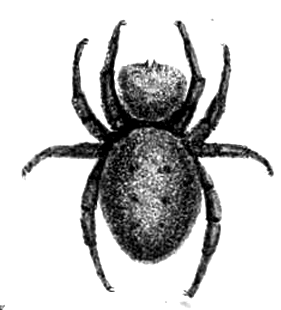
Habitus, dorsal view
(Dufour 1820)
Distribution List
References
Bacelar A (1936) Notas aracnológicas. III. Aranhas ibéricas da familia Eresidae. Boletim da Sociedade Portuguesa de Ciencias Naturais 12: 179-183 
Benhacene R, Adjami A, Hadjeb A, Kermiche K, Ouakid M L (2023) Bibliographic checklist of the Algerian spider fauna (Araneae). Zootaxa 5352: 301-357
Bosmans R (2003) A checklist of the spiders of Tunisia, with description of a new species of Palliduphantes Saaristo & Tanasevitch (Araneae: Linyphiidae). Kaupia - Darmstädter Beiträge zur Naturgeschichte 12: 89-109
Dufour L (1820) Description de six arachnides nouvelles. Annales Générales des Sciences Physiques 4: 355-366
Kmira G, Nasri-Ammar, Petillon J, Bosmans R (2025) Catalog of the spiders of Tunisia (Arachnida: Araneae). Zootaxa 5641: 1-95
Pantini P, Isaia M (2018) Checklist of the Italian spiders (version June 2018).
WSC (2026) World Spider Catalog. Version 27. Natural History Museum Bern, online at http://wsc.nmbe.ch (20.5.2026) doi: 10.24436/2
Updates
| 04-05-2026 | Gallery image insert | |
| 20-04-2026 | Datasheet update | Detail |
| 20-04-2026 | Distribution insert | Detail |
| 09-07-2025 | Distribution update | Detail |
| 25-02-2022 | Distribution insert | Detail |
| 15-07-2020 | Distribution update | Detail |
| 22-01-2015 | Image insert | |
| 29-12-2014 | Distribution update | Detail |
| 25-06-2013 | Distribution update | Detail |