Oonops procerus Simon, 1882
Description
Male
Palp: bulb large, pear-shaped, embolus short, strongly widened at the top, forming a cylindrical lobe. Legs: femur I without spines.
Body length male: 2-2.24 mmFemale
Vulva with 2 strong grooves on the surface of the epigyne. Prosoma light brownish-red. Eyes large, subequal. Clypeus a little more narrow than anterior eyes. Legs light grey-yellow, femur broad and flat, tibia I and II with 4 pairs of strong ventral spines, metatarsus I and II with 2 pairs of strong ventral spines, femur I with 3 or 4 prolateral spines, femur II, III and IV with only one dorsal spine, tibia and metatarsus III and IV with 2 pairs of lateral and 2 pairs of ventral spines. Opisthosoma oblong oval, bright orange-red. Cuticula with sparse strong hairs.
Body length female: 2.6-2.8 mmAdditional information
In fresh or dry habitats, decisuous, coniferous or mixed forests, among litter and moss, or under stones.
Distribution
Phenology
| Jan | Feb | Mar | Apr | May | Jun | Jul | Aug | Sep | Oct | Nov | Dec |
 |  |
Figures
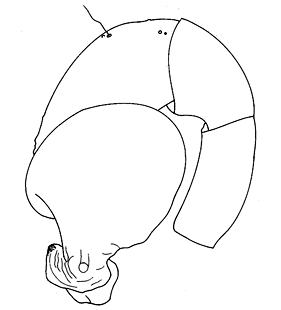
Pedipalp
(Duffey & Brignoli 1981)
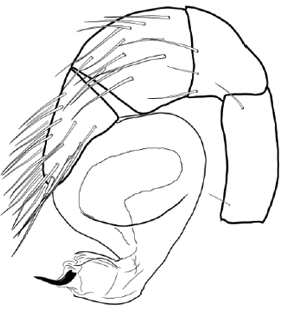
Pedipalp
(Breitling 2020)
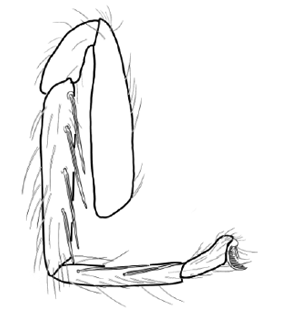
Leg I, prolateral view
(Breitling 2020)
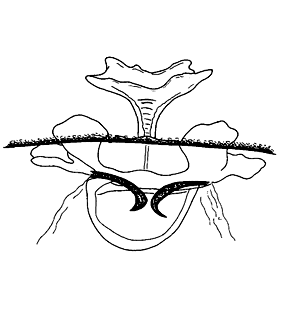
Vulva
(Duffey & Brignoli 1981)
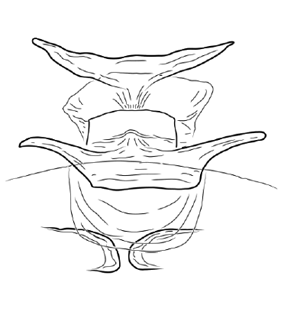
Endogyne, dorsal view
(Breitling 2020)
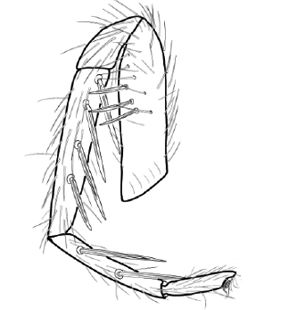
Leg I, prolateral view
(Breitling 2020)
Distribution List
References
Branco V V, Morano E, Cardoso P (2019) An update to the Iberian spider checklist (Araneae). Zootaxa 4614: 201-254 
Breitling R (2020) South European spiders from the Duffey collection in the Manchester Museum (Arachnida: Araneae). Arachnology 18: 333-362
Duffey E, Brignoli P M (1981) Two rare spiders from the Spanish Pyrenees (prov. Huesca). Bulletin of the British Arachnological Society 5: 155-158
Le Peru B (2007) Catalogue et répartition des araignées de France. Revue Arachnologique 16: 1-468
WSC (2026) World Spider Catalog. Version 27. Natural History Museum Bern, online at http://wsc.nmbe.ch (20.5.2026) doi: 10.24436/2
Updates
| 22-09-2025 | Distribution update | Detail |
| 25-07-2020 | Image insert | |
| 10-12-2013 | Image insert |